



How did Copenhagen become Europe’s green capital?
Mobility, urban planning, innovation… the choices that transformed the Danish capital into a global benchmark for sustainable cities.
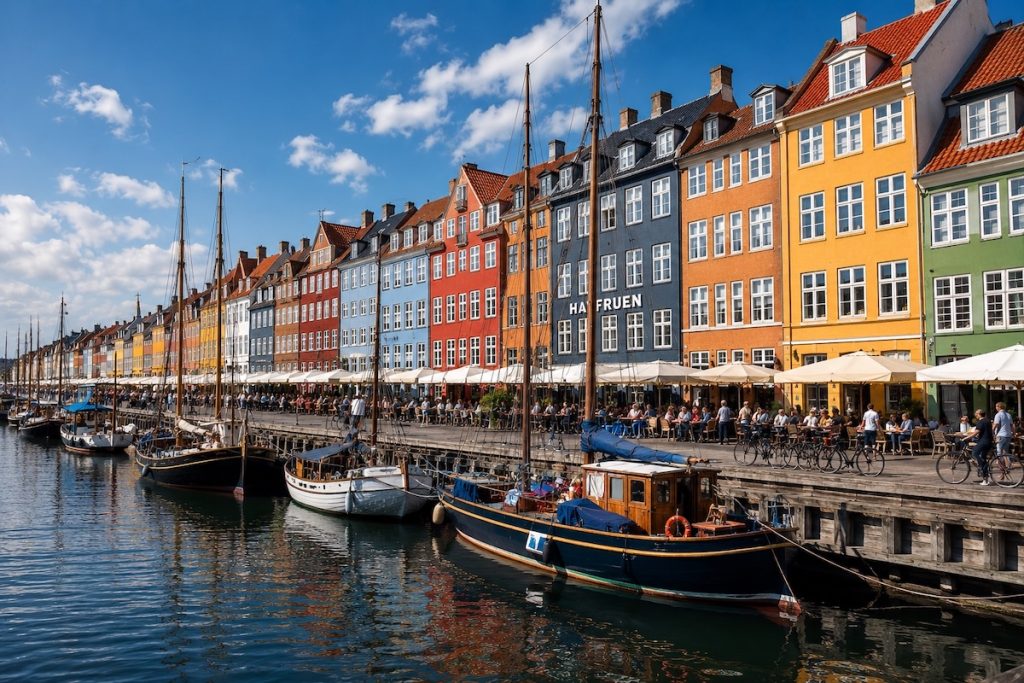
From cycling culture to green transport, including eco-friendly hotels and smart bins… Copenhagen stands as a model for sustainable development. It is no coincidence that the Danish city was elected “European Green Capital 2014”.
Cycling culture. With over 160 km of cycle paths and 55% of its inhabitants commuting daily by bike, Copenhagen’s reputation for cycling culture is well established. Proof of this is that the capital of Denmark was the first city in the world to be named “official cycling city” by the International Cycling Union.
Green transport. The metro can also be a good way to get around the Danish capital, according to a 2008 study in which transport experts awarded the urban rail system the title of “best metro in the world.”
Furthermore, Scandinavian Airlines is one of the first airlines to have introduced an ecological approach, by reducing fuel consumption after landing. The goal? To reduce emissions by 20% by 2020.
Eco-friendly hotels. Few European cities can boast that 63% of their hotel rooms are eco-certified. This is the case for Copenhagen, where the majority of hotels have adopted an environmental plan aimed at respecting water usage, cleaning, waste, energy consumption, food, smoke, and heating.
Sustainable design. In 2013, Copenhagen received the Index Award, the world’s most important international design prize. This is hardly surprising given that 90% of construction waste is reused and a proactive climate plan for the future, which includes developing more sustainable design solutions, has been implemented.
Smart bins and cars. According to Marius Sylvestersen, head of Copenhagen Solutions Lab, an organization created in 2014 that will soon launch “Street Lab,” a test zone in the city center of the Danish capital, “sensors are being tested on urban furniture, particularly bins that could send information on their fill level to optimize the use of garbage trucks by telling them where and when to go.”
Another example under study: 20 to 40% of motorists driving in the city are looking for a parking space. “If a message is sent to them about the nearest parking space, significant fuel savings are made, and CO2 emissions are reduced,” explains Marius Sylvestersen.
Green lungs in the green city. Like many green cities, Copenhagen has clean bathing waters, abundant parks and nature reserves. Furthermore, 96% of the Danish capital’s inhabitants can reach a large green or blue space on foot in less than 15 minutes. What’s more, Copenhagen has just launched a major nature restoration project, and new urban gardens are invading the city.
As you can see, ecological initiatives aimed at improving Copenhagen’s urban environment continue to multiply. The medium-term objective? To make the city of the Little Mermaid the world’s first carbon-neutral city before 2025. A challenge that seems far from impossible for a green city like Copenhagen.
IN BRIEF
FRENCH
3 MIN READ
TOURISM • SUSTAINABLE DEVELOPMENT
CONTENT TYPE
Investigative and analytical article
THE CHALLENGE
To transform a series of ecological initiatives into a coherent narrative illustrating the global vision of a city that has become a world reference for sustainable development.
SHARE