

Is French still the language of the Olympic Games?
Given the dominance of English, what place remains for the French language in the world’s biggest sporting event?
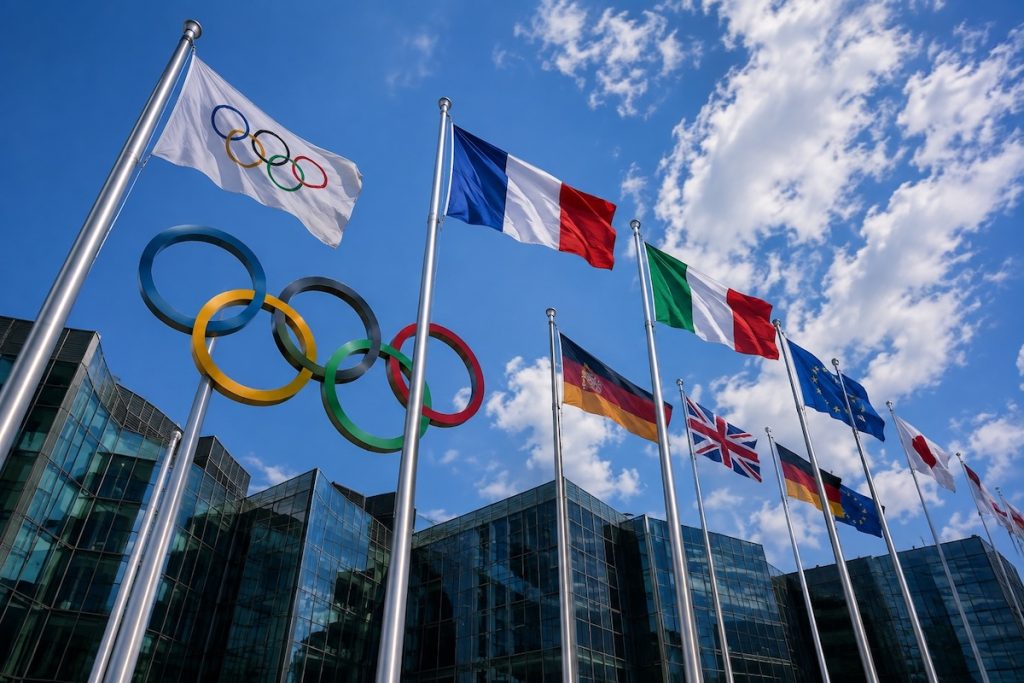
The Olympic Charter is explicit: French is, along with English, the official language of the Olympic Games. However, Molière’s language has been losing ground for several years to Shakespeare’s. Is there cause for concern just days before the opening of the Rio Games? Assimil answers you.
Official Language of the Games according to the Olympic Charter
How many people know that French is the primary language of the International Olympic Committee (IOC) and therefore “THE” official language of the Olympic Games? Probably few, judging by the reactions of British spectators who seemed annoyed during the entry into Queen Elizabeth Olympic Park at the opening ceremony of the London 2012 Games. The reason? Her Majesty’s arrival was announced first in… French, then in English. There is nothing very surprising about this, however, if one takes a quick look at the Olympic Charter.
Indeed, this document published in 1908 – which incorporates certain rules written by Pierre de Coubertin in 1899 – stipulates via Article 24 that « the official languages of the International Olympic Committee are French and English » (stated in that order). What’s more, « in case of divergence between the French and English texts of the Olympic Charter and any other IOC document, the French text shall prevail, unless otherwise stipulated in writing ».
To ensure compliance with this rule, a personality from the Francophone world is tasked with observing the place of French during each Olympic event. In 2012 in London, this was Michaëlle Jean, former Governor General of Canada. Among other things, she had to verify that all Olympic sites used Molière’s language. This role of Grand Witness was created in 2004 for the Athens Olympic Games by the IOC following the non-observance of French-English bilingualism during previous Games. It should be noted that in 2008 in Beijing, this mission was entrusted to a certain Jean-Pierre Raffarin, former French Prime Minister. Unfortunately, despite all the efforts made by these Grand Witnesses, « French slowly found itself out of the Games » remarked journalist Patrick Lafayette, following the Sochi 2014 Winter Olympics.
French is losing ground to English
Some consider the omnipresence of French at the Olympic Games obsolete and demand that its status as an official language be reviewed. Their main argument? The use of two official languages – French and English – would incur additional costs (particularly concerning the translation and editing of official documents and regulations). It would therefore be more logical, according to proponents of a linguistic evolution of IOC protocols and regulations, to use English, now a universal language, as well as the language of the host country.
A discourse that makes the head of the Observatory of the French Language, Alexandre Wolff, react strongly: « Contrary to what many believe, English does not facilitate communication. Its systematic use degrades its practice and does not promote mutual understanding. This is particularly detrimental in forums where consensus is sought ». It is difficult to contradict him given the often-observed example of translators who must first retranscribe very approximate international English into academic English, before it can be translated into other languages. He added: « if one day French were to disappear from the Olympic landscape, it would be replaced neither by Spanish nor by Chinese. The presence of French at the Games guarantees the cultural diversity of the event. The OIF primarily defends multilingualism. It is certainly necessary to find a balance and be pragmatic. But to resign oneself to de facto unilingualism would be a serious mistake ».
How to put French back at the heart of the Games?
The Rio Olympic Games have already begun the search for eight thousand volunteers, whose mission will be to be “the voice of the Olympic Games,” and who will be assigned to the “protocol and languages” section. Among the linguistic services these volunteers will offer are interpretation in more than thirty languages of everything that happens during the Games – including Amharic, the official language of Ethiopia, Swahili (Kenya), and Urdu (Pakistan) – as well as support for delegations from over two hundred countries.
To restore the image of French in the longer term, the OIF (International Organisation of La Francophonie) will have to continue its efforts to develop and provide Francophone expertise, with the creation of a network of young translators and interpreters, as well as several professionals with Olympic experience. The objective? To maintain a high level of demand for the quality of the translations offered. In this regard, the website “Le français j’adore” must also become a real tool for raising awareness and mobilizing the general public, particularly young people, in order to promote Francophone and international sport in French.
Beyond the Olympics and sport, the stakes are major for French. According to Claude Hagège, professor at the Collège de France, « imposing one’s language is also imposing one’s way of thinking, because language structures an individual’s thought. Some believe that French thought can be promoted in English: they are wrong ». As proof, he cites this statement by the great mathematician Laurent Lafforgue: « It is not because the French school of mathematics is influential that it can still publish in French; it is because it publishes in French that it is powerful, because this leads it to take different paths of reflection ». A word to the wise…
IN BRIEF
FRENCH
6 MIN READ
SPORT • LANGUAGES
CONTENT TYPE
Investigative and analytical article
THE CHALLENGE
To address a linguistic and institutional issue from a general public perspective, showing that the stakes extend far beyond sport to cultural diversity.
SHARE